A journey into the fascinating paradox of Italian gastronomy: how the regional cuisines we celebrate today are actually a modern construct, born of historical necessity, emigration, and national unification.
The myth of immutable tradition
For the food and wine enthusiast who seeks not only pleasure but also historical accuracy in food, the time has come to confront an uncomfortable truth: what we celebrate today as "Italian regional cuisines" is, to a large extent, a modern construct. It is not an immutable legacy handed down from the dawn of time, but a skillful synthesis—some scholars even call it postmodern—capable of blending heterogeneous elements from diverse locations, often from neighboring regions.
This process of reassembly has removed traditional dishes from their original context, marked by daily poverty and hunger, and placed them within a framework of well-being and food security, irreparably altering their dietary, symbolic, and ritual value. Establishing a "tradition" in such a changed context is essentially equivalent to inventing a new tradition.
From contempt to the cult of territory: an ideological reversal
The cosmopolitan haute cuisine of the past
To understand the invention of Italian regional cuisines, we need to shift our perspective from the past. The idea of elevating territory to a specific dimension of gastronomic culture is by no means a pre-modern one.
In the central centuries of the Middle Ages and the early modern period, elite haute cuisine actively sought to overcome localism, perceived as a symbol of peasant poverty. The table of the privileged, where local products were mixed with goods from international channels in a sort of "global table," served precisely to mark social difference. The ideology of the time established that the crucial distinctions were between people—the ruling classes versus the subordinate—and not between places.
The liberal-democratic revolution
For this image to be overturned and for territory to acquire culturally significant value, a previously inconceivable principle had to be affirmed: equality (at least theoretically) among men. It was only with the advancement of liberal-democratic thought, supported by the development of the bourgeois class and the industrial economy between the 18th and 19th centuries, that "territory" could assume a distinctive value in food identities.
Macaroni: The Story of a National Stereotype
Naples and the seventeenth-century revolution
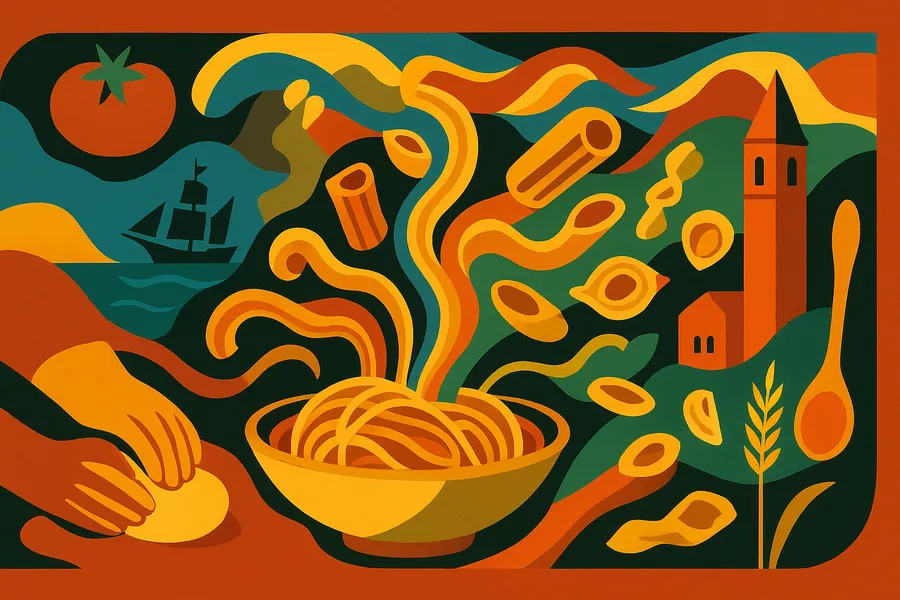
Among the countless insulting nicknames linked to local eating habits that populated the Italian gastronomic network—from "turnip eaters" to "polenta eaters"—one in particular stood out, assuming a unifying role: that of "macaroni eaters," or, in the broadest and most modern sense of the term, pasta eater.
This stereotype, far from being a relic of ancient traditions, is a relatively recent construct, born of necessity and technological revolution. Its transformation into a national stereotype occurred with sudden acceleration in the first half of the 17th century, and its epicenter was Naples.
Under Spanish rule, the chronic inefficiency of the city market and production difficulties led to a progressive depletion of primary resources that had once been crucial to the popular diet, particularly meat and vegetables. This shortage caused a drastic imbalance in dietary balance, pushing the population toward a massive consumption of carbohydrates: bread and, especially, pasta.
The democratization of pasta
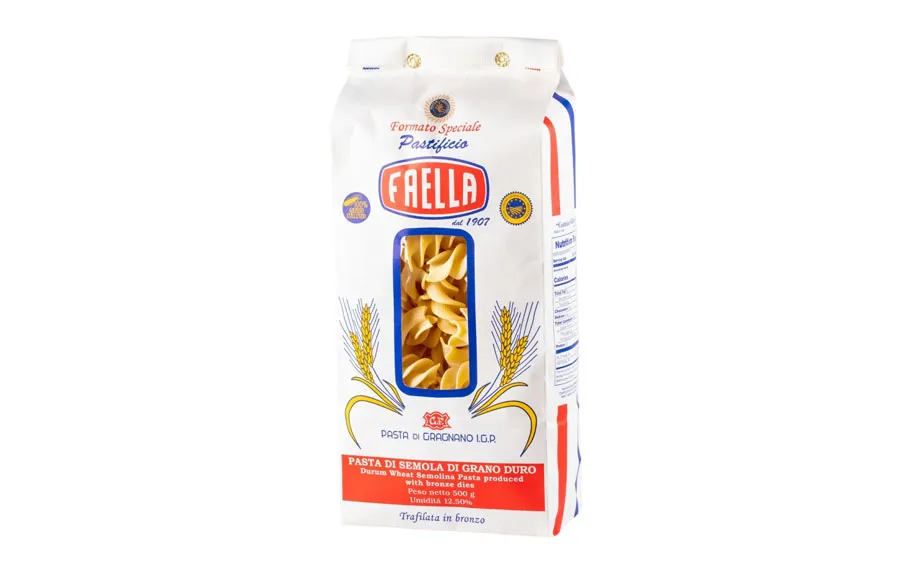
Until then, pasta had been a somewhat luxurious product, so much so that in times of famine its production was prohibited to avoid using flour for bread production. But it was a small but decisive technological revolution that democratized this food. The widespread use of the kneading machine and the invention of the mechanical press allowed pasta to be produced at significantly lower costs. Thus, from a semi-elite commodity, it became, for the first time, a truly popular food, the staple of the daily diet of the urban poor.
From the 17th century onward, it was the Neapolitans who earned the nickname "macaroni eaters," replacing the Sicilians who, in the Middle Ages, had first adopted the Arab model of dried pasta. The pasta-and-cheese combination, which during the 19th century was joined by tomato sauce—a combination that represented a brilliant dietary solution in its own right—took precedence over the traditional cabbage-and-meat pairing.
Unification: From Municipal Symbol to National Identity
Cavour's gastronomic metaphor
Despite its deeply Southern roots, macaroni became a powerful national symbol during the crucial unification process. As Garibaldi's troops awaited the landing on the continent, Count Cavour used the gastronomic metaphor to describe the annexation of the South. Cavour wrote that "the macaroni are cooked and we will eat them," an expression that, beyond possible malicious interpretations of the North "devouring" the South, reflected the Piedmontese political class's desire to establish itself as the guarantor of the traditions of all Italians.
Through this operation, the symbol of Naples was transformed into a symbol of the nation, implementing a true "southernization" of the Italian gastronomic image, capable of ideally pulling "the Mediterranean blanket further north".
Emigration: the forging of the global stereotype
The real cement that cemented the "macaroni eater" stereotype in the global collective imagination, however, was the dramatic phenomenon of mass emigration in the final decades of the 19th century. Millions of Italians, mostly from southern Italy, spread across Europe and overseas.
Pasta consumption was immediately recognized as the defining element of this Italian "diversity." In America, a land perceived as abundant and "Carnival realized," the dream of pasta, which in its homeland had often remained unfulfilled for the poorest, finally found easy realization. It was in these overseas communities that many southern farmers "became 'macaroni eaters'" and that the quintessential Italian-American dish was born: spaghetti with meatballs.
The forced encounter between individuals and families from different areas of the peninsula led to a "food syncretism" in restaurants and domestic habits that, in many cases, anticipated similar experiences in the country of origin.
The transition from city to region
The primacy of municipal tradition
In Italy, the valorization of territorial identities initially followed the municipal tradition, which had historically shaped the country's culture. Until the unification of Italy, cookbooks featured almost exclusively "urban" references (The Bolognese Cook, The Genoese Cook), reflecting the city's hegemony over its surrounding countryside.
The attempt to define identity on a regional basis was a later process, which developed in parallel with the country's political unification. This push for "regionalization" paradoxically ran counter to Pellegrino Artusi's unifying project.
In 1891, Pellegrino Artusi published "Science in the Kitchen and the Art of Eating Well," a work that would revolutionize Italian cuisine. The Romagna-born Florentine aspiring chef aspired to build an Italian network of culinary knowledge, not to confine it to watertight compartments.
Artusi collected recipes from all over Italy during his travels as a textile merchant, creating a collective work written with Italians through a close exchange of correspondence with his readers. From the initial 475 recipes, the book grew to contain 790, taking its final form only in 1911. The work has gone through 111 editions, with over 1.5 million copies sold, and has been translated into numerous languages.
As historian Piero Camporesi stated, "Science in the Kitchen did more for national unification than The Betrothed." Artus's "gustemi" succeeded in creating a national identity code where other attempts at cultural unification failed.
The institutional codification of regional cuisines
The role of the Italian Touring Club
The first cookbook to classify dishes according to regional perspective, "La nuova cucina delle speciale regionali" by Vittorio Agnetti, appeared in Milan in 1909. Subsequently, the national-popular rhetoric of fascism emphasized the motifs of ruralism and regionalism, a paradoxical counterpart to a centralizing statism.
The most incisive moment of codification was the launch, in 1928, of the first inventory project of Italy's food heritage, created by the Italian Touring Club and published in 1931 with the "Gastronomic Guide of Italy".
This is where the crucial ambiguity arises: the forced classification of recipes and products within the conventional and predefined boundaries of administrative regions. This operation was clearly forced, and only partially corresponds to historical and cultural reality, creating artificial connections where they did not exist and breaking them where they were historically rooted.
Unlike contemporary French maps, organized around the centralized Paris market, Italian maps confirmed the profoundly decentralized dimension of Italy's cultural heritage, appearing topographically fragmented and irreducible to "politically" determined spaces.
Regional cuisines in the 21st century
A modern invention with commercial purposes
"Regional cuisine" is, in conclusion, a modern invention that responds primarily to political, commercial, and tourism needs, not merely cultural ones. From a purely cultural perspective, it would be more accurate to refer to local, territorial, or urban cuisines, inserted into a national circuit that integrates them, according to the fundamental model of the network.
This overlapping of politics and culture has transformed the image of national gastronomy, conferring arbitrary regional identities on its extraordinary richness. Today, this regional image has also been exported and reinforced abroad, where supermarkets and the food industry offer schematic and often fanciful versions of sauces or pasta shapes labeled "Lombard" or "Sicilian," reassuring consumers of their connection to the region with the tricolor flag.
The true essence of Italian cuisine
However, this "screen" of regions risks obscuring the true identity of Italian cuisine: its absolutely local and, at the same time, profoundly national nature. Italy has never known a Dante of gastronomy or a culinary Accademia della Crusca; it has had figures like Bartolomeo Scappi or Pellegrino Artusi, who limited themselves to comparing and networking local traditions, without imposing a single model.
The true essence of our gastronomic architecture lies precisely in the rediscovery of dialectal character and the full legitimacy of each variant, a model particularly suited to supporting the glocal challenge of the future, appreciating municipal pride and the richness of a thousand local identities.
A dynamic and ever-evolving identity
Italy's gastronomic identity, though deeply rooted in a thousand local and urban flavors, has been defined as "national" only through its circulation, cultural exchange, and reworking in contexts of great social transformation. The history of macaroni and regional cuisines is a powerful demonstration that identity is never static or ancestral, but is built dynamically, day after day, through constant exchange and adaptation.
For the discerning enthusiast, understanding this complexity doesn't diminish the value of Italian culinary traditions, but rather enriches them with a historical and cultural depth that makes them even more fascinating. Every dish we bring to the table tells a story of necessity, innovation, travel, and encounters: a living narrative that continues to be written every day in our kitchens, our restaurants, our markets, and in Italian communities around the world.
Italian cuisine is not a museum of traditions frozen in time, but a living organism that breathes, adapts, and reinvents itself, while maintaining the common threads that inextricably link it to the land, the seasons, the finest ingredients, and the artisanal expertise that transforms simple ingredients into masterpieces of flavor. It is this tension between local roots and openness to the world, between fidelity to origins and the capacity for innovation, that makes Italian gastronomy unique and recognizable everywhere.
Further information and sources:
For those who wish to delve deeper into these fascinating topics, we recommend Massimo Montanari's seminal work on the history of Italian food, Alberto Capatti's studies on Italy's gastronomic culture, and, of course, Pellegrino Artusi's original "Science in the Kitchen and the Art of Eating Well," still available today in numerous editions and a reading experience that goes far beyond a simple recipe book.
The critical rediscovery of these historical roots takes nothing away from the pleasure of the table, but rather enriches it with awareness: every bite becomes a journey through time, every recipe a page of Italian history.
Bibliography
1. "Italian Cuisine: History of a Culture" by Massimo Montanari and Alberto Capatti - A fundamental work on the history of Italian gastronomy. https://www.laterza.it/scheda-libro/?isbn=9788842076759
2. Casa Artusi - A center of gastronomic culture dedicated to Pellegrino Artusi and Italian home cooking
https://www.casartusi.it/it/
3. Treccani - "Discovery and Invention of Regional Cuisine" - An encyclopedic study of the origins of regional cuisines
https://www.treccani.it/enciclopedia/scoperta-e-invenzione-della-cucina-regionale_(L'Italia-e-le-sue-Regioni)/
4. Slow Food Editore - Dictionary of Italian Regional Cuisine with 8,500 entries from A to Z
https://www.slowfoodeditore.it/it/slowbook/dizionario-delle-cucine-regionali-italiane-9788884996145-876.html
5. CREA - "Italian Cuisine: Our History" - A historical-cultural journey from pasta to Artusi's culinary unification
https://creafuturo.crea.gov.it/11214/




 Italiano
  Espanol
  German
  French