The Deep Roots of Taste: The Mediterranean Tradition Between Nature and Culture
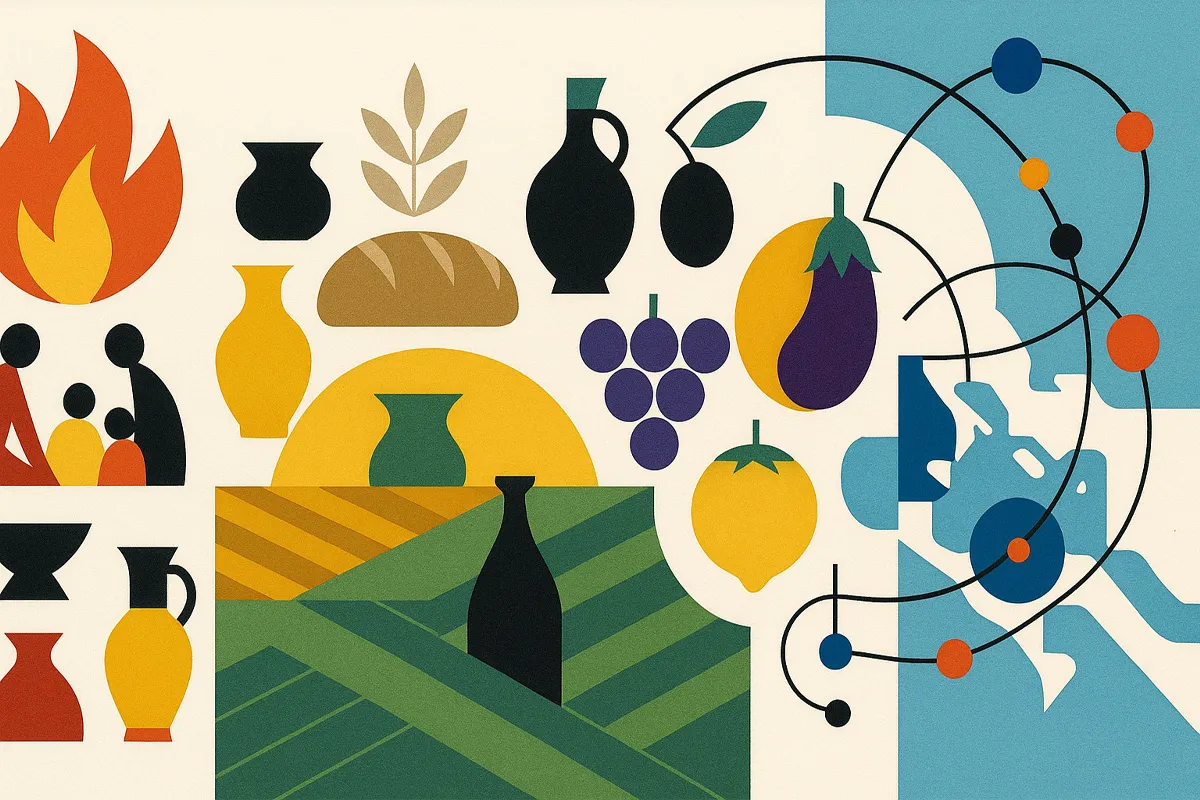
In the crackling of that first conquered flame - or perhaps stolen from the gods, as the ancient myth of Prometheus tells - one of the most decisive evolutionary passages in human history took place. Not just a tool to defend oneself from the cold or to forge tools, fire became the catalyst for an anthropological revolution: the birth of cooking, an invisible but insurmountable divide between humanity and the rest of the animal world. This founding moment marks the beginning of that Mediterranean tradition that would profoundly shape not only the tastes but the entire cultural identity of the civilizations surrounding the Mare Nostrum.
The specificity of the human being does not simply reside in the act of eating, a biological necessity shared with every living creature, but in deliberately transforming food through cooking. This primordial gesture traces a clear boundary between nature and culture , between the raw — symbol of the wild universe — and the cooked, emblem of human dominion over natural elements. No other being on the planet has developed this behavior with the systematicity and complexity of man, making cooking not only a survival technique, but a language of cultural communication .
The advent of agriculture, probably driven by the growing inadequacy of the hunting and gathering economy in the face of expanding populations, represented a further break with the pre-existing natural order. Man stopped passively adapting to nature, and instead began to bend it to his needs, starting an almost paradoxical cycle: greater agricultural production meant more food available, which allowed for a larger population, which in turn required further intensification of production. In this process of detachment from the feral condition, two elements became central: the preparation of food through fire and the forcing of the earth to produce specific foods.
Every ancient civilization crystallized its identity around particular symbolic foods : bread in the Mediterranean basin, rice in eastern and southern Asia, millet and sorghum in African cultures, corn in pre-Columbian civilizations. Bread, which today might seem like an everyday and almost banal product, represented for the ancient world the culmination of an incredibly sophisticated technological process - from sowing to milling, from fermentation to cooking - so much so that in the Homeric poems it became a synecdoche (from the Greek "to understand together") for man himself. Similarly, wine and olive oil became emblems of the classical Mediterranean tradition, foods that, significantly, were perceived as "artificial", the fruit of human ingenuity rather than simple gifts of nature.
The social dimension of food emerges as a further distinctive element of humanity. Plutarch argued that human beings are not born to eat, but to eat together. Although some animal species know forms of food sharing, man - a social animal by definition, according to the famous Aristotelian definition - has elevated this moment to a complex ritual, full of meanings. The convivium , etymologically "living together", becomes a tangible metaphor for community life, transforming nourishment from a mere physiological necessity to an elaborate communicative system, an expression of social, economic and identity values.
The shared table is not only a space for nourishment, but a theater where social hierarchies are reflected and crystallized: the seating of the diners, the portions assigned, the quality of the food served — everything participates in a choreographed nonverbal language that defines status and belonging. In this sense, the historical study of food transcends the investigation of "what" was eaten to explore "what" was intended to be communicated through food.
Omnivory, a biological characteristic of human beings, introduces a further cultural element into the food equation: the need for choice . Being able to potentially eat "everything" requires a selective act that implies aesthetic, ethical and symbolic evaluations deeply rooted in the culture of belonging. Culinary history thus appears as an incessant process of contamination, where apparently indigenous traditions reveal themselves, upon closer inspection, to be the result of stratified encounters between different civilizations.
The ancient Mediterranean , cradle of intense commercial exchanges and primordial forge of the Mediterranean tradition; the encounter-clash between Roman and Germanic cultures in the early Middle Ages; the fundamental Arab contribution, which not only introduced revolutionary products such as citrus fruits, aubergines, spinach, sugar and pasta, but also acted as a cultural mediator between East and West ; finally, the discovery of America, which brought corn, potatoes, tomatoes, cocoa and turkey to Europe — these are all chapters of this narrative made up of continuous adaptations and redefinitions of identity.
The integration of new foods into established traditions has never been immediate or free from resistance, following dynamics similar to the introduction of neologisms into a language : a slow process of acceptance in which the foreign element is gradually assimilated, sometimes replacing pre-existing practices, other times alongside them in an original synthesis.
The kitchen is thus revealed not as a static monument to be preserved unchanged, but as a living organism in perpetual evolution , rooted in the alchemical transformation brought about by fire, developed through increasingly sophisticated agricultural practices, expressed in the social sharing of meals and constantly renewed by the encounter between different cultures. This is the most precious legacy of the Mediterranean tradition: a paradoxical identity, which finds its most authentic essence in mutation and exchange.




 Italiano
  Espanol
  German
  French