Paleo Diet: What Evolution Really Teaches Us About Nutrition
There comes a point in every educated person’s life when it becomes clear that the most seductive stories are often the ones furthest from reality. The Paleo diet is one such modern enchantment: it promises a return to the supposed food paradise of hunter-gatherers, where every morsel was naturally perfect for our bodies. It’s a narrative that consoles us in our contemporary food anxieties, but it crumbles when we subject it to the scrutiny of serious science.
The problem is not that this story is completely false. The problem is that it is dangerously incomplete, and this incompleteness is leading us to nutritional conclusions that contradict everything we know about human evolution.
The Deception of Simplicity
There is something deeply human in our need to simplify the past. We want to believe that our ancestors had discovered perfect formulas, that there was a time of harmony between man and nature where everything worked better. The commercial paleo diet exploits this need with a skill that borders on marketing genius: it transforms evolutionary complexity into a marketable dietary protocol.
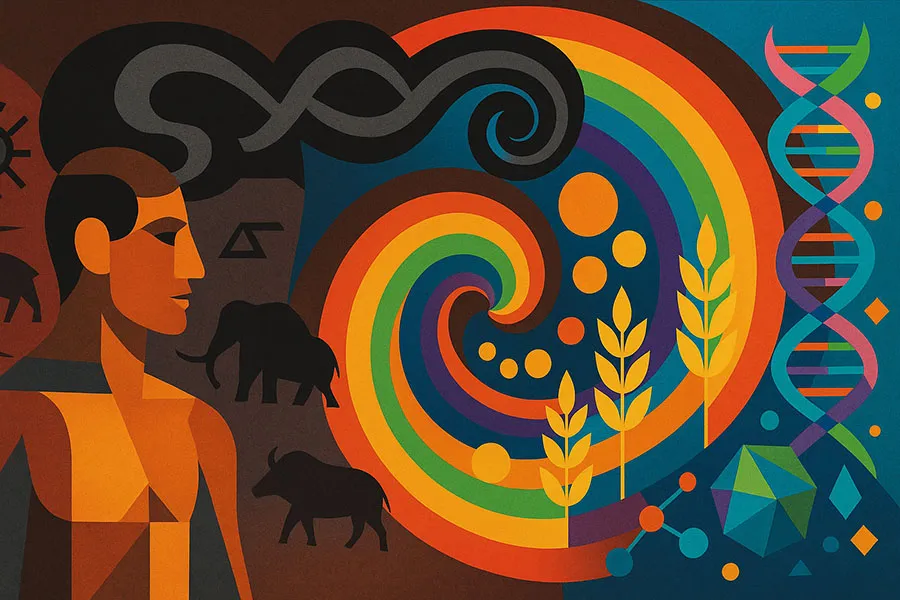
But reality is stubborn. The Paleolithic was not a long weekend in human history: it spanned over two million years, during which different human species existed with nutritional needs often incompatible with ours. Homo erectus, Homo heidelbergensis, the first Sapiens who left Africa: each of them had to solve the problem of survival in radically different environmental contexts.
When Paleo diet theorists talk about "ancestral nutrition," which of our ancestors are they referring to exactly? And most importantly, why should we assume that they solved the nutritional problem better than we did?
The Lost Geography of Flavor
What emerges from the archaeological evidence is a mosaic of adaptations that defies any attempt at standardization. Neanderthals on the Portuguese coast ate massive amounts of seafood, probably developing specific digestive mechanisms for this type of diet. Their contemporaries in the European hinterland did not have access to these resources and developed completely different dietary strategies.
Every ancient human group did what every human group has always done: adapted its diet to the surrounding environment, experimented, discarded what didn't work, preserved what guaranteed survival. There was no Paleolithic manual of the perfect diet. There was only the adaptive intelligence of species that had to survive with what they found.
This should teach us something fundamental: flexibility, not rigidity, is the secret to human evolutionary success.
The myth of forbidden grains
One of the most popular claims of the contemporary Paleo diet is that there were no grains in the Paleolithic diet. It's a theory that only sounds convincing until we compare it to what we actually know.
Wild grains were available and consumed. How else could we explain the development of agriculture? No one wakes up one morning and decides to grow a plant they have never tasted. Agriculture arose because our ancestors had already discovered the nutritional value of grains in their wild form and wanted to ensure a more stable supply.
The archaeological evidence is overwhelming. The oldest European grinding tools, found in Liguria and Lazio, date back 40-42,000 years. Analysis of dental calculus from ancient remains reveals unmistakable traces of plant starches. Sapiens and Neanderthals in the Middle East consumed cereals and legumes long before anyone thought of agriculture.
But there is something even deeper: the systematic use of fire, attested for hundreds of thousands of years, had already made it possible to cook and digest foods such as legumes, neutralizing antinutrients. Our ancestors were not inexperienced gatherers who chewed raw roots. They were already sophisticated food processors.
The Evolution That Waits for No One
The fundamental assumption of the Paleo diet – that our bodies have been frozen in evolutionary amber for tens of thousands of years – is probably the most serious scientific error in the entire theory.
Human evolution did not pause when we discovered agriculture. On the contrary, it accelerated. Adaptations occurred with a speed that defies any traditional concept of biological time.
Consider amylases, the enzymes that digest starch. In populations with a long agricultural history, there has been an extraordinary multiplication of genetic copies of these enzymes. We are not talking about a technical detail: this adaptation has allowed entire civilizations to thrive on cereals, it has made possible the demographic development that led to the birth of cities, art, philosophy.
Lactose tolerance in adulthood tells an even more dramatic story. Developed over the past 3,000 years, it has spread with astonishing evolutionary speed. During medieval famines, this ability determined who survived and who died. Those who could feed on the milk of their own animals had a decisive advantage.
These are not isolated cases but examples of a more general rule: our body has constantly adapted to dietary changes. We are what we are not despite agriculture, but because of it.
The Mesolithic and the Art of Adaptation
The Mesolithic period offers a remarkable window into human adaptability. As the climate warmed after the last ice age, our ancestors didn't just mourn the lost megafauna; they reinvented their feeding strategy.
They began to consume hazelnuts massively when hazelnut forests expanded. They developed new fishing techniques to exploit aquatic resources. They perfected bow hunting to catch smaller and more agile prey. Every environmental change became an opportunity to explore new food possibilities.
This phase of experimentation reveals something essential about human nature: we are born food explorers. The idea of a rigid, unchanging Paleolithic diet contradicts everything we know about our evolutionary history. Our ancestors were flexible nutritional opportunists, not orthodox followers of a fixed dietary protocol.
The proportions that changed the world
What really changed during the Neolithic was not the introduction of completely new foods, but the specific weight of each food in the overall diet. Cereals went from being secondary players to absolute protagonists. This transformation guided the evolutionary adaptations that still characterize us today.
Ironically, our contemporary consumption of grains may be lower than that of the Middle Ages or Ancient Egypt. The modern paleo diet often fights ghosts, ignoring that the food proportions of the past were very different from what we imagine.
Beyond the romance of benign nature
The Paleo diet is based on a deeply romantic vision of nature as a provider of nutritional wisdom. It is a seductive but scientifically untenable idea. Nature is not an organic supermarket designed for our needs: it is an indifferent system where organisms adapt to what they find or perish.
Discovering that our Mesolithic ancestors consumed snails does not mean that we should include a pound of gastropods in our daily menu. Archaeology informs us of the diversity of survival strategies, it does not prescribe an optimal diet. The idea that everything "natural" is automatically beneficial is a fallacy that ignores millennia of cultural and scientific evolution.
Our ancestors ate what they could find because they had no alternatives. We have the luxury of informed choice, guided by scientific tools they could not even imagine.
When Science Wins Over Nostalgia
Contemporary nutritional guidelines converge globally not by accident, but because they are based on a body of scientific evidence built through decades of rigorous research. From Italy to Japan, Australia to Brazil, the recommendations exhibit a remarkable consistency that reflects the strength of the underlying data.
These studies look at real populations, measure long-term health effects, control variables, identify correlations and causation. The commercial paleo diet, on the other hand, is based on inevitably incomplete archaeological reconstructions and often forced interpretations of fragmentary data.
The results speak for themselves: balanced diets like the Mediterranean, rich in whole grains, legumes, fruit, vegetables, fish and quality oils, offer documented benefits for longevity, cardiovascular prevention, cognitive health. It is not nutritional ideology, it is empirical evidence.
The Ecological Elephant in the Room
There is one aspect of the paleo diet that its proponents prefer to systematically ignore: the ecological impossibility of their project on a global scale. Eight billion people cannot return to hunting and gathering without causing immediate environmental collapse.
Contemporary human civilization exists because we have learned to produce food intensively through agriculture. Cereals and legumes are not the enemies of our health, but the pillars that make it possible to feed huge masses of people with a relatively sustainable environmental impact.
To imagine a world that abandons this foundation to return to "Paleolithic" dietary proportions – typically rich in animal protein – is to accelerate the destruction of the Earth's ecosystems. The intensive livestock farming needed to meet such proportions on a global scale would represent an unprecedented ecological disaster.
The dangers of simplification
Extreme diets derived from the Paleo concept, such as the exclusively carnivorous one, can produce apparently positive effects in the short term: rapid weight loss, improvement of some blood parameters, feeling of energy. These results are often used as "proof" of the validity of the Paleolithic approach.
But nutritional science has taught us to distinguish between short-term and long-term effects. Initial weight loss may simply result from involuntary caloric restriction due to the high satiety of high-protein foods. Metabolic improvements may reflect the reduction of processed foods rather than the intrinsic superiority of an ancestral diet.
In the long term, extreme diets can cause microbiota imbalances, excess iron, damage from compounds resulting from cooking meat, nutritional deficiencies. The complexity of the human nutritional system requires balanced approaches, not monochromatic solutions.
The true lesson of evolution
The history of human nutrition does not teach us that there was a golden age to be replicated, but something much more precious: the extraordinary capacity for adaptation that characterizes us as a species.
This evolutionary flexibility is not a legacy of the past but an active resource of the present. We continue to adapt, both biologically and culturally. Asian populations are developing greater tolerance to dairy products. Changes in global dietary habits are influencing the composition of the human microbiota on a planetary scale.
Evolution is not a museum to visit but a living process that passes through us. The paleo diet, in its commercial version, artificially freezes this process, transforming the evolutionary dynamic into a static marketing product.
Towards a mature nutritional wisdom
In an age obsessed with simple solutions and gurus who promise magic formulas, the true story of human nutrition reminds us that complexity is our most authentic nature. There are no shortcuts to health that pass through nostalgia for an idealized past.
The contemporary challenge is not to go back but to move forward with wisdom, integrating the evolutionary flexibility that has brought us this far with the scientific tools we have developed to understand nutrition. We must learn from our ancestors not what to eat, but how to eat: with adaptability, pragmatism, openness to experimentation.
The future of human nutrition will not be a replica of the past but an intelligent synthesis between tradition and innovation, between ancestral wisdom and scientific knowledge, between ecological sustainability and individual well-being.
The True Legacy of the Paleolithic
Our ancestors left us something much more precious than a food recipe: they gave us the ability to adapt, to experiment, to survive in different environments with different resources. This evolutionary legacy lives on in us and represents our most precious resource to face the nutritional challenges of the present.
The commercial paleo diet betrays this legacy by turning it into dogma. The real paleolithic lesson is that there are no universal food dogmas, only adaptive strategies that work in specific contexts. In the 21st century, our context includes modern nutritional science, the need for environmental sustainability, the complexity of globalized societies.
Honoring our ancestors means using their flexibility to create new solutions, not mechanically replicating their survival needs.
Evolution is not nostalgia but continuous innovation. The best diet is not the one that takes us back to the past but the one that prepares us for the future, integrating the adaptive wisdom of our ancestors with contemporary scientific knowledge to create a sustainable, healthy and humane diet.
Scientific resources
Health Benefits and Risks
The paleo diet is rich in fruits, vegetables, protein, and unsaturated fats, and free of refined grains and added sugars. It can lead to short-term improvements in body weight, waist circumference, blood pressure, and some lipid and inflammatory parameters. [ link ] [ link ] [ link ] [ link ]
However, it often exceeds recommended limits for saturated fat and cholesterol, and may be deficient in carbohydrates, fiber, calcium, and potassium, potentially increasing the risk of cardiovascular disease and nutritional deficiencies. [ link ] [ link ] [ link ] [ link ]
Excluding dairy, legumes and grains can reduce your intake of essential nutrients such as calcium, fibre and some vitamins. [ link ] [ link ] [ link ]
No adverse health effects have been observed in short-term studies in healthy adults and athletes, but data on long-term effects and in vulnerable populations are lacking. [ link ] [ link ] [ link ]
Limits of Scientific Evidence
Available studies are often short-term, with small sample sizes and heterogeneous results. Observed benefits are generally modest and not always clinically relevant. [ link ] [ link ] [ link ]
Meta-analyses suggest caution in interpreting the results, as the quality of the evidence is variable and long-term safety data are lacking. [ link ] [ link ] [ link ]
The paleo diet has not been sufficiently evaluated for bone health and safety across all age groups. [ link ] [ link ] [ link ]




 Italiano
  Espanol
  German
  French