Why Commercial Coffee Can't Compete With Specialty: A Journey From Quality to Degradation
We enter any supermarket. Endless shelves of coffee stare at us with glittering promises: "golden blend," "Italian tradition," "intense aroma." Every package screams excellence, but what's really behind these claims? The truth is that mass-market coffee represents the exact opposite of what a quality product should be. Not out of bad faith, but due to an economic logic that has systematically sacrificed every aspect of quality on the altar of price and volume.
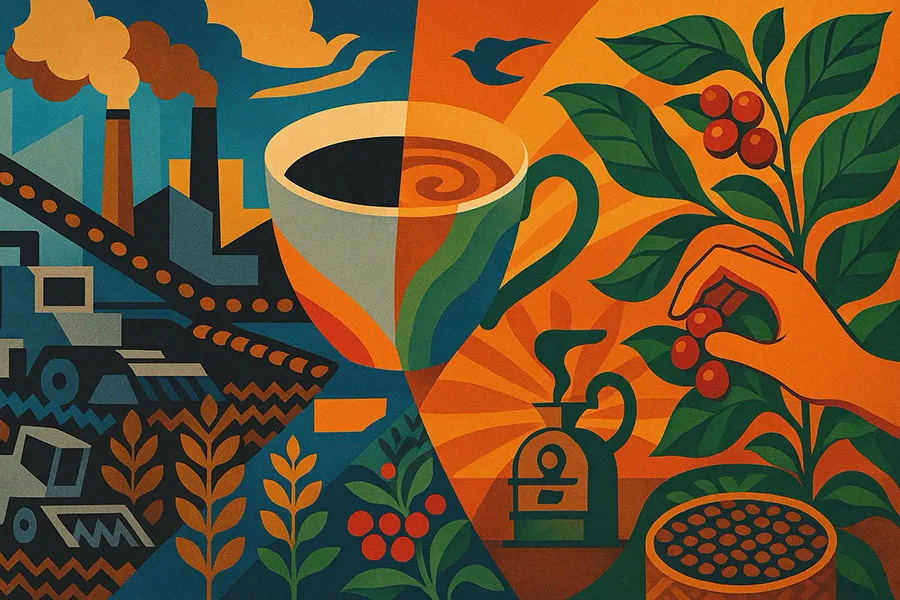
The betrayal begins in the fields, where endless plantations stretch like monotonous green oceans. Imagine an orchestra where all the instruments play the same note: this is what happens in commercial monocultures, where biodiversity has been erased to maximize yield. We're no longer talking about agriculture, but about green industry. The trees grow in direct sunlight, an unnatural condition for a plant that in nature thrived under the protection of other species. The result? Fruit that ripens too quickly, without developing the aromatic complexity that only comes from slow ripening at altitude.
While in specialty fields, pickers pass over the same tree multiple times, selecting only the perfectly ripe cherries, in commercial coffee, a single pass collects everything: ripe, unripe, overripe, and even the fermented ones that fall to the ground. It's as if a winemaker were to simultaneously harvest green, ripe, and rotten grapes to make wine. The result is predictable: a heterogeneous product where the defects outweigh the qualities.
Industrial processing completes this work of systematic destruction. Specialty coffee (we discussed its distinctive characteristics in a previous article ) ferments under controlled conditions, monitoring pH, temperature, and time to develop the desired flavor profiles. Commercial coffee ferments as it happens, often developing obvious defects: inappropriate fermentation notes, musty hints, a metallic aftertaste. Accelerated drying represents the final blow: while specialty coffee dries slowly in the sun or under controlled conditions to preserve the essential oils, commercial coffee is forced through high-temperature mechanical dryers. It's like baking bread in the microwave instead of the oven: technically possible, qualitatively disastrous.
Commercial coffee beans can remain in containers for months, traveling across oceans and different climates. During this time, they absorb moisture, odors, and contaminants that irreversibly compromise their aromatic profile. Specialty coffee, on the other hand, reaches roasters within weeks of processing, preserving its organoleptic characteristics intact. In industrial warehouses, bags of green coffee can remain stacked for years. Coffee is a living product that continues to evolve after harvest, and not always for the better. Slow but inexorable oxidation progressively degrades its oils and aromas.
Industrial roasting represents the ultimate betrayal of this chain of degradation. It uses extremely high temperatures for extremely short periods, three to five minutes versus the twelve to eighteen minutes of specialty coffee . Why? Not to enhance the coffee's aromas, but to hide its flaws. A dark roast literally burns everything : the flaws disappear, but with them, every positive characteristic of the bean. All that remains is bitterness, astringency, and that burnt aftertaste that many mistake for "intensity."
While a specialty roaster processes batches of five to fifteen kilograms, carefully monitoring every variable, an industrial roaster processes two to five hundred kilograms at a time. It's physically impossible to guarantee roast uniformity on such large batches. The result? Burnt beans mixed with raw beans in a haphazard distribution of defects. "Quakers"—beans that don't develop properly during roasting and remain pale and dense—are removed manually in specialty coffee. In commercial coffee, they remain in the blend, contributing bitter and astringent notes that detract from the overall experience.
Packaging completes this theater of deception. Check any commercial coffee package: you'll find expiration dates extending up to twenty-four months, but rarely a roast date . Why? Because it would reveal that the coffee was roasted months, if not years, before purchase. Specialty coffee always bears the roast date clearly visible: it's a mark of quality and freshness. Commercial coffee is often packaged in a normal atmosphere, accelerating oxidation. Specialty coffee uses one-way valves that allow gases to escape without letting oxygen in, preserving the aromas.
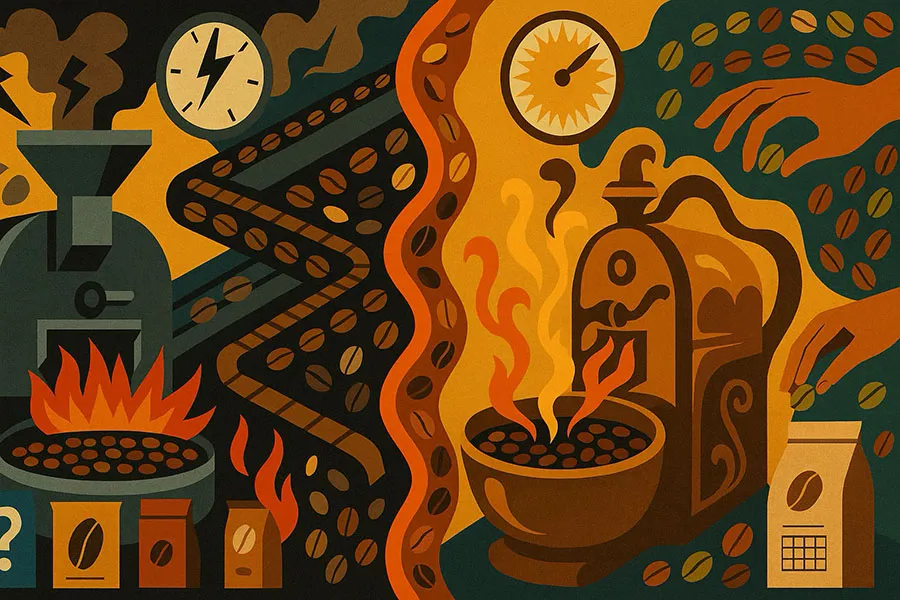
Commercial coffee exhibits unmistakable characteristics in the cup: a dominant bitterness that overpowers every other aroma , a lingering burnt or rubbery aftertaste, a lack of natural acidity and liveliness, a body that appears to be due to defects not quality, and a one-dimensional aroma devoid of complexity. It's the result of a supply chain that has systematically eliminated every element of quality to optimize costs and shelf life. The thick, dark crema of commercial espresso isn't synonymous with quality, but is often the result of high percentages of low-quality Robusta beans, over-roasting that creates excess CO2, and the presence of degraded oils that create an unstable foam. Specialty coffee produces a less thick but more stable, golden, and persistent crema.
Commercial coffee seems convenient, but it hides enormous social and environmental costs : exploitation of producers paid below production costs, environmental devastation through intensive monocultures, loss of biodiversity in regions of origin, financial speculation that disconnects price from quality. The commercial system treats coffee as a commodity, not as a complex agricultural product . Prices are determined by the exchanges, not by the actual quality of the product.
While Italy remains anchored to the myth of commercial espresso, the rest of the world has embraced a quality revolution. Australia, Northern Europe, Japan, and even producing countries are developing sophisticated coffee cultures that value origin, process, and expertise. Our taste is culturally conditioned. Generations of Italians grew up drinking commercial coffee, developing a tolerance for bitterness and losing sensitivity to aromatic nuances. But taste can evolve. Just as we've learned to appreciate complex wines beyond table wine, we can educate our palates to recognize true quality in coffee.
Every cup of specialty coffee we choose is a vote for the economic sustainability of the producers, environmental respect in the cultivation, artisanal excellence in the processing, and an authentic sensory experience. Commercial coffee isn't "wrong": it's the product of a system that has optimized everything except the human experience. Understanding these mechanisms restores the power of informed choice. Every specialty cup you drink becomes an act of resistance against industrial degradation.
We're not trying to convince you to abandon your habits. We're simply telling you what lies behind them, what lies beyond. The real difference, the one you can taste, the one that changes your experience. With Tumn, this awareness becomes a tangible experience. For years, we've been connecting authentic producers to curious consumers across Europe, building a quality network that transcends national borders. The first food and wine food hub of Italian excellence , where the story of each product comes to life: the place to discover the true difference between industrial and artisanal food, between a casual choice and a conscious one. We don't judge other people's habits; we simply offer an alternative to those who want to discover what it truly means to "bite the difference."




 Italiano
  Espanol
  German
  French