The table as a mirror: the history of food between health, power and pleasure
Over the centuries, the table has been much more than a simple place dedicated to nourishment — it has transformed into a complex theater where dietetics and gastronomy, medicine and pleasure, biological necessity and the display of power intertwine. The history of food reveals these profound connections between apparently distant spheres of human experience, where the search for taste is inextricably intertwined with that of health and social identity.
In pre-modern Europe, cooking and medicine spoke a common language, articulated around the theory of the four humors developed in classical Greece and systematized by Galen in the second century. This paradigm, dominant until the dawn of the modern era, postulated that every living being and every food possessed a specific "nature" determined by the combination of fundamental qualities - hot/cold and dry/wet - a reflection of the four primordial cosmic elements. Perfect health was conceived as an ideal balance of these qualities in the human body, a balance that could be maintained or re-established through a scientifically calibrated diet.
The culinary practices of the time were not guided only by aesthetic or gustatory considerations, but found their deepest legitimacy in this medical vision of the world. Cooking techniques , combinations of different foods, the succession of courses responded to the need to "temper" the intrinsic nature of foods, balancing their qualities towards an ideal point of equilibrium. The history of nutrition shows us how the meat of older animals, considered excessively dry, was boiled to increase its moisture; classic combinations such as cheese with pears or melon with ham — which today might seem simple gastronomic traditions — actually represented sophisticated applications of Galenic science , aimed at balancing the cold and moist nature of fruit with warm and dry elements.
Sauces, far from being mere exaltations of taste, played a crucial corrective role, modifying and tempering the nutritional virtues of the meats with which they were associated. Even the structure of the meal followed a precise dietary architecture: it began with salads or acidulous fruit to "open" the stomach, continued with moist dishes , reached the climax with the roast - the "main course" - accompanied by its sauces, to conclude with "astringent" foods such as cheeses and dried fruit, intended to "close" the stomach, often accompanied by sweet and spicy wines believed to be beneficial for digestion. Digestion itself was conceived as an internal cooking process , in ideal continuity with the external cooking carried out in the kitchen.
In this integrated perspective, the pleasure of taste was not in contradiction with the needs of health, but was interpreted as a natural compass , a reliable indication: what is most pleasant to the palate tends to also be what best adapts to the digestive needs of the organism.
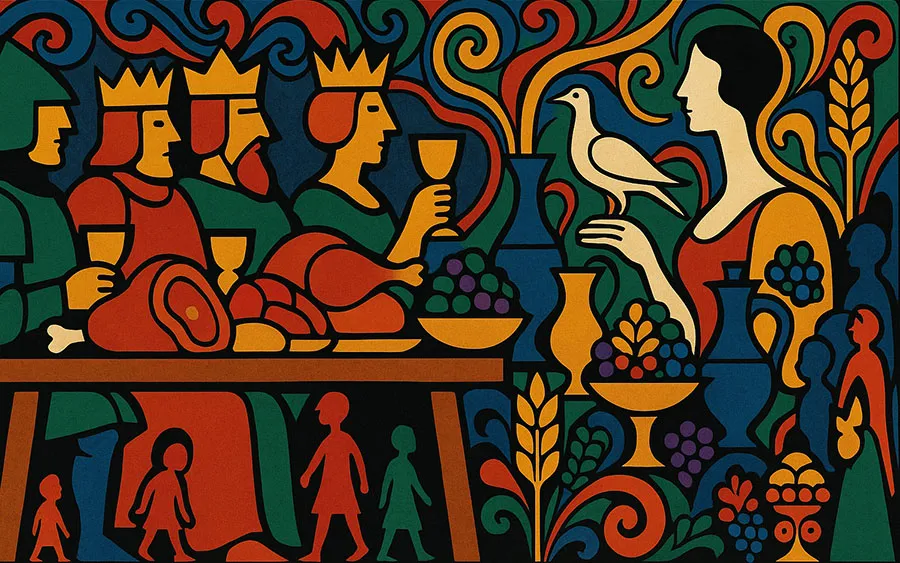
In parallel with the dietary dimension, food has always represented a powerful instrument of social distinction . The history of food documents how, in societies historically marked by endemic hunger or its looming spectre, food abundance and freedom from the daily constraints of nourishment constituted the most evident discrimination between the powerful and the subordinates, the rich and the poor . Especially in the Germanic tradition that permeated medieval Europe, eating copiously took on the characteristics of a demonstration of physical strength and social prestige ; the great eater became a positive figure, a social model that traced animal dynamics, where the leader of the pack manifested his supremacy also through the privilege in access to food. A sovereign who did not eat enough could even be considered unfit to govern.
Meat, in particular, believed to be capable of infusing physical strength into the body, became the emblematic food of the powerful, of the aristocratic medieval warrior . The deprivation of meat, especially of large game - wild boar, deer, bear - which was hunted with techniques similar to those of war, represented one of the most severe punishments . With the progressive transformation of the nobility from a warrior caste to a courtly elite , abundance at the table was transformed from a duty demonstrating strength into an acquired right and a manifestation of wealth ; preferences shifted from heavy meats to lighter poultry, better suited to an intellectual and diplomatic lifestyle .
The symbolism associated with body fat reveals the evolution of this social concept of nourishment. Until the mid-twentieth century, being "fat" - or, with various euphemisms, healthy, robust, plump - was a positive ideal, a tangible sign of economic well-being, the ability to afford abundant and nutritious foods, especially meat rich in fat. Cities like Bologna were celebrated as "fat" to praise their opulence and wealth. An imaginary drastically overturned by the contemporary ideal of thinness, associated with efficiency and probably introduced by the eighteenth-century bourgeois mentality, in a context where the ancestral fear of hunger gradually gave way to the fear of excess.
The religious dimension also profoundly influenced this complex panorama. The Christian monastic tradition , in opposition to the aristocratic ethic of abundance, promoted models of moderation, abstinence - particularly from meat - and fasting, understood as instruments of penance and spiritual perfection. Paradoxically, monasteries themselves became centers of avant-garde gastronomic development, developing innovative techniques to enhance the "alternative" foods permitted during periods of abstinence: fish farming, advanced horticulture, dairy production. The liturgical calendar, with its rigid alternation between "fat" days (with meat) and "lean" days (fish, vegetables, cheese), gave a distinctive rhythm to dietary practices.
What began as penitential mortification gradually became an opportunity for extraordinary culinary creativity, and the focus on lean foods transformed, in the modern age, into an explosion of gastronomic refinement that greatly enriched the heritage of techniques and recipes.
The table thus emerges as a prismatic mirror of civilization , a reflective surface where the precepts of medical science , the dynamics of social power , the obligations of faith and the search for sensory pleasure converge. Delving into the history of food means exploring these apparently distinct but profoundly interconnected dimensions in an overall cultural system that has defined, century after century, our relationship with food and, through it, with ourselves.




 Italiano
  Espanol
  German
  French